
Case study · Full-stack · NLP
PromptCraft AI
turns rough ideas into ready-to-use prompts
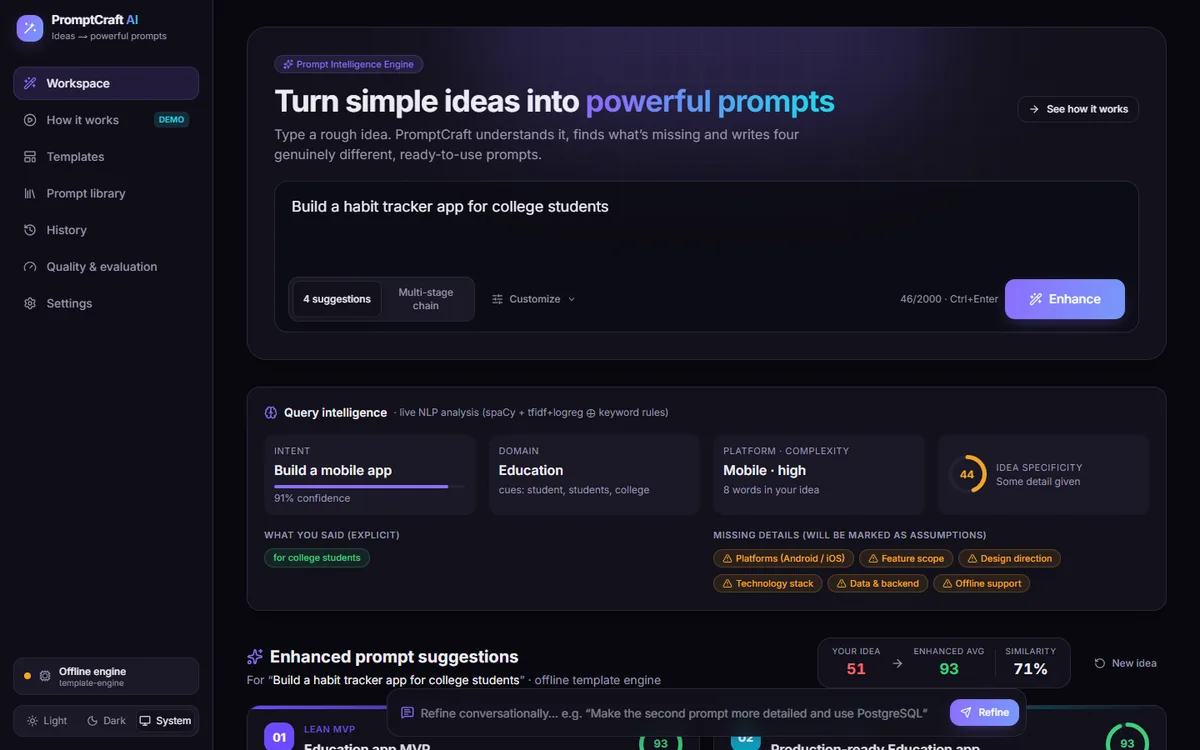
A web app that takes a one-line idea, works out what it means and what is missing, and writes four different, detailed prompts for it, each scored for quality. Classical NLP does the understanding, any LLM you choose does the writing, and an offline engine takes over when there is no API key.
The problem
Most people ask an AI tool for something in one vague line, like "make an e-commerce website", and get a generic answer back. The details that make a prompt useful (platform, scope, stack, design, constraints) are missing, and people don't know what they left out.
What the research found
- On a benchmark of 18 ideas across categories, PromptCraft's prompts averaged 95/100, against 49 for the original idea and 52 for a manual expansion, using the offline engine with no LLM.
- Completeness rose from 0 to 96 and specificity from 2 to 100: the gains come from filling in what the idea never said, not from rewording it.
- Intent was detected correctly for all 18 ideas, and 89% of generated prompts passed every validation check.
Decisions that shaped it
- 1
Understand first, then write. spaCy and a TF-IDF and logistic-regression intent classifier, backed by keyword rules, work out intent, domain and platform, and separate what you said from what is missing. Missing details are stated as assumptions, not quietly invented.
- 2
Four genuinely different strategies, not four rewordings: a lean MVP, a full production build, a design-focused version and an AI-enhanced one, with a diversity check that rejects near-duplicates.
- 3
Quality is a number, not a feeling. Every prompt is validated and scored on clarity, completeness, specificity, consistency, intent preservation, actionability and diversity.
- 4
Works with any model: Gemini, OpenAI, Claude, Groq, OpenRouter, Ollama or any OpenAI-compatible API, with keys kept on the server. With no key at all, an offline template engine still writes all four prompts.
- 5
Refine by talking. "Make the second prompt more detailed and use PostgreSQL" changes only that card, with a word-level compare of versions and one-click restore.
Built with
- Next.js
- TypeScript
- Tailwind CSS
- FastAPI
- Python
- spaCy
- scikit-learn
- SQLAlchemy